
You feel fine all day long. Then you get into bed, lie down, and your tooth starts throbbing. Dealing with a toothache at bedtime is miserable. It keeps you awake and makes getting a good night of rest almost impossible.
The main reason your tooth hurts more at night comes down to simple physics. When you lie flat, more blood flows straight to your head and face. That extra blood pressure puts pressure on the sensitive nerve inside your tooth. During the day, gravity pulls blood down toward your body, which keeps the pressure lower. Daytime activities also keep your mind busy. In a dark, quiet room, your brain notices every bit of pain much more clearly.
Common Causes of Nighttime Tooth Pain
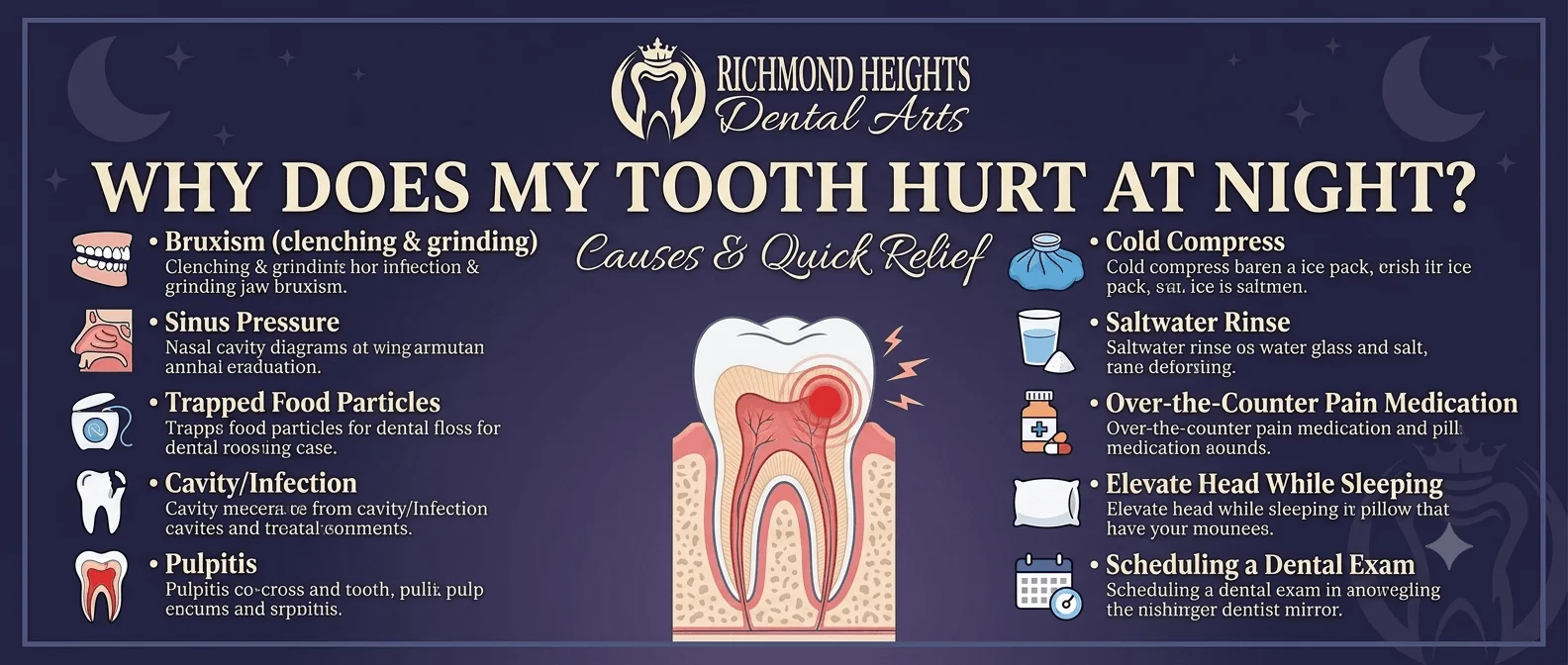
A few different problems can trigger a toothache at night. One big reason is clenching or grinding your jaw while you sleep. This constant pressure can contribute to bite problems and jaw discomfort, which may sometimes be addressed with Bite Adjustment. Many people grind their teeth without even knowing it. That constant pressure wears down your enamel, stretches your root ligaments, and leaves you with sore teeth in the morning.
Deep cavities are another common cause. When decay gets through your enamel and reaches the soft inner nerve, the tooth may become severely inflamed. Depending on the extent of the decay, treatment may involve a Dental Filling or another restorative procedure and sometimes require root canal therapy. Sinus issues can also be the culprit. Your upper back teeth sit right under your sinus cavities. If your sinuses fill up with fluid and pressure at night, that pressure pushes down on your tooth roots.
How to Relieve Toothache at Night for Fast Comfort
If a toothache wakes you up at night, you can try a few easy steps to calm it down. First, prop your head up with two or three pillows. Sleeping on an incline keeps blood from rushing to your head. That takes pressure off the hurting nerve right away.
Rinsing your mouth with warm salt water also helps. It cleans out trapped food particles that might be irritating your gums. You can also hold an ice pack wrapped in a cloth against your cheek for fifteen minutes to numb the area. Taking over-the-counter pain medicine helps bring down nerve swelling so you can catch some sleep.
How Dentists Fix Nighttime Tooth Pain
Pillows and ice packs help you get through the night, but they do not fix the actual problem.
If your tooth continues to hurt at night, you should schedule a dental exam. Your dentist may also recommend Dental X-Rays to identify problems that cannot be seen during a visual examination If decay or a crack is causing the pain, your dentist will first evaluate the tooth and determine the appropriate treatment.
Depending on the damage, treatment may include a Dental Filling for a cavity or Dental Crowns for a weakened or damaged tooth Dentists use strong, metal-free Zirconia crowns for back molars that do heavy chewing and grinding. For front teeth, translucent E-Max ceramic crowns blend in perfectly with your real enamel. A strong ceramic crown seals out bacteria, protects the nerve, and puts a permanent stop to nighttime tooth pain.
Frequently Asked Questions
-
Why does my tooth hurt at night than during the day?
Ans. When you lie flat, more blood flows to your head. This increases pressure on the nerve inside your tooth, making the pain feel much sharper at night. -
How can I stop a toothache at night so I can sleep?
Ans. Elevate your head with extra pillows, rinse your mouth with warm salt water, put a cold pack on your cheek, and take over-the-counter pain medicine. -
Does sleeping with your head elevated help a toothache?
Ans. Yes. Keeping your head higher than your body stops blood from pooling in your head, which lowers fluid pressure on your tooth nerve. -
Can grinding your teeth make them hurt at night?
Ans. Yes. Clenching or grinding your jaw in your sleep puts huge pressure on your teeth, leading to cracks, sore roots, and morning jaw pain. -
Can sinus pressure cause tooth pain at night?
Ans. Yes. Your upper back teeth sit right under your sinus passages. When sinus pressure builds up at night, it pushes down on your tooth roots. -
What does a throbbing toothache at night mean?
Ans. A throbbing toothache usually means the nerve inside your tooth is severely inflamed or infected and needs attention from a dentist. -
Is a toothache at night a dental emergency
Ans. These symptoms may indicate a dental emergency and should be evaluated by a dentist right away.”. -
How does a dentist fix a tooth that hurts at night?
Ans. Your dentist will remove any decay or infection and protect the tooth. They often place a custom metal-free Zirconia or E-Max ceramic crown over the tooth to seal out bacteria and stop nerve pain for good.